
 Client Login

With the One Big Beautiful Bill Act (OBBBA) now fully in effect, 2026 is the first year many of my clients are feeling the full weight of the new rules. The tax brackets are permanent, the SALT cap is much higher (with an income limit), charitable deductions work differently, and there’s a brand-new savings account for kids called the Trump Account. Here are 10 things I’m reviewing with clients so they can make the most of these changes before December 31.
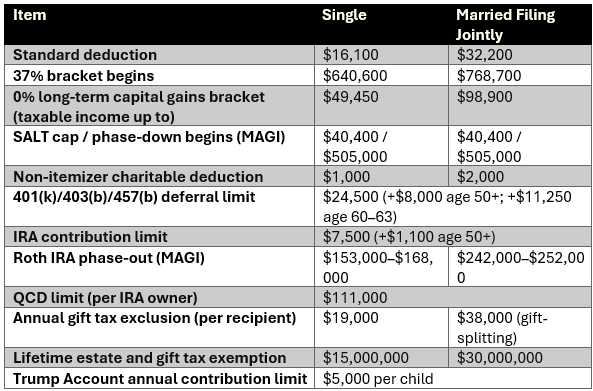
2026 Key Numbers at a Glance
These are the 2026 limits and thresholds I get asked about most this time of year. Each one is explained in more detail in the sections below.
1. Know Where You Fall in the 2026 Tax Brackets
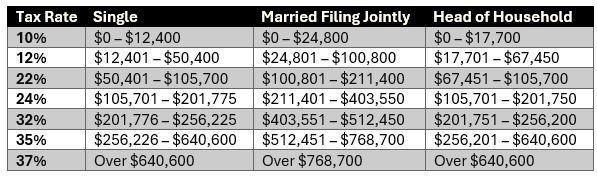
The OBBBA made the seven federal brackets permanent (10%, 12%, 22%, 24%, 32%, 35% and 37%), so there’s no longer a sunset to plan around. “Permanent” here means the law has no built-in expiration date. Congress can still change the brackets in the future, as it can with any part of the tax code. For now, year-end planning comes down to managing income between this year and next. For 2026, the 37% bracket starts at $640,600 for single filers and $768,700 for married couples filing jointly.
If you expect to be in a lower bracket next year, for example because you’re retiring or a business sale is wrapping up, consider deferring bonuses or accelerating deductions. If you expect a higher bracket next year, or you still have room in a lower bracket this year, consider pulling income into 2026 to fill up the current bracket. A partial Roth conversion is a common way to do this.
The table below shows the 2026 federal marginal tax brackets, based on taxable income:
2. Check Your Estimated Tax Payments
Underpayment penalties are avoidable with a little planning. To stay penalty-free, your withholding and estimated payments generally need to cover the smaller of these two amounts:
- The prior-year safe harbor: 100% of your 2025 tax liability (110% if your 2025 AGI was over $150,000, or $75,000 if married filing separately)
- The current-year method: 90% of your actual 2026 tax
The prior-year safe harbor gives you a known target when your income is rising. If your 2026 income is down significantly, the 90% method may let you pay less.
If you’re behind, you can increase your W-2 withholding before year-end or take an IRA distribution with withholding. Withholding is treated as paid evenly throughout the year, so it can make up for earlier quarters. A fourth-quarter estimate (due January 15, 2027) doesn’t fix underpayments from earlier in the year, though it still reduces the penalty. Remember your state estimates too.
3. Compare the Standard Deduction and Itemizing
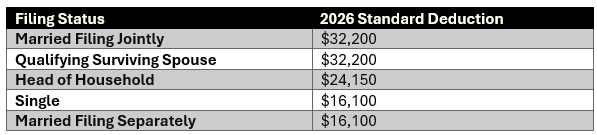
For 2026, the standard deduction varies by filing status, as shown below. With the higher SALT cap, more households will find that itemizing makes sense again, so run the numbers before assuming you’ll take the standard deduction. If you’re close to the line, consider bunching. That means concentrating deductible expenses like charitable gifts and elective medical expenses into one year so you can itemize, then taking the standard deduction the following year. Where your local rules allow it, property tax payments can sometimes be timed the same way.
Several new OBBBA deductions are available even if you don’t itemize. These include the additional $6,000 deduction for taxpayers 65 and older (subject to income phase-outs), and the deductions for qualified tips, qualified overtime pay and interest on qualifying new U.S.-assembled vehicle loans. Keep the documentation to support them.
4. Manage Income Around the SALT Cap Phase-Down
The cap on state and local tax (SALT) deductions rose to $40,400 for 2026 ($20,200 if married filing separately), but it phases down for higher earners. Once modified AGI goes over $505,000 ($252,500 if married filing separately), the cap drops by 30% of the excess. It bottoms out at $10,000 at roughly $606,000 of MAGI. Inside that range, your effective marginal rate ends up well above your bracket.
If your income is near the threshold, it can pay to stay below it. Strategies include:
- maximizing pre-tax retirement contributions
- timing capital gains and bonuses
- harvesting losses
- using qualified charitable distributions in place of taxable IRA withdrawals
- spreading Roth conversions across several years
Business owners should also check if a state pass-through entity tax (PTE) election makes sense, since it moves state taxes off the individual return and outside the SALT cap entirely.
5. Plan Around the New Charitable Contribution Rules
Starting in 2026, charitable giving works differently for everyone.
Non-itemizers can now deduct up to $1,000 ($2,000 for joint filers) of cash gifts to qualifying public charities. Gifts to donor-advised funds and private foundations don’t qualify for this deduction.
Itemizers can only deduct the portion of their gifts that exceeds 0.5% of AGI. For anyone in the 37% bracket, the tax benefit of itemized deductions is also capped at 35%.
For larger donors, a donor-advised fund (DAF) is still one of the most flexible tools. You can make a large contribution in one year, ideally with appreciated stock you’ve held for more than a year, so you avoid capital gains tax on the growth. You take the deduction now and recommend grants to your favorite charities over time. Bunching several years of giving into a DAF can help you clear the 0.5% floor and get above the standard deduction.
Qualified Charitable Distributions (QCDs) from IRAs
If you’re 70½ or older, a QCD lets you send money directly from your IRA to a qualifying charity, up to $111,000 per person for 2026. The distribution is excluded from income, and it counts toward your required minimum distribution (RMD) if you’re 73 or older.
A QCD lowers your AGI directly, with no itemized deduction involved, so it can help in several ways at once:
- avoiding the 0.5% floor
- staying under the SALT phase-down threshold
- lowering Medicare IRMAA premiums
- reducing the taxable portion of Social Security
QCDs have to go straight to the charity (DAFs don’t qualify), and the funds need to leave the IRA by December 31.
6. Maximize Workplace Retirement Accounts
Salary deferrals to a 401(k), 403(b) or governmental 457(b) have to go through payroll by December 31. Check your year-to-date contributions now while there are still paychecks left.
For 2026, the employee deferral limit is $24,500. Savers 50 and older can add an $8,000 catch-up. Those aged 60 through 63 get an $11,250 “super catch-up” in place of the regular one.
New for 2026, if your prior-year FICA wages were over $150,000, your catch-up contributions have to go in as Roth (after-tax), so check how your plan is handling this.
If you’re self-employed, look at Solo 401(k) and SEP IRA options too. A Solo 401(k) generally has to be set up by year-end to accept 2026 employee deferrals.
7. IRA Contributions and Backdoor Roth IRAs
The 2026 IRA contribution limit is $7,500, plus a $1,100 catch-up if you’re 50 or older. You have until April 15, 2027, to make 2026 contributions, but year-end is a good time to plan them. Direct Roth IRA contributions phase out between $153,000 and $168,000 of MAGI for single filers and between $242,000 and $252,000 for joint filers.
If your income is above those limits, a backdoor Roth may still work. You make a nondeductible traditional IRA contribution and then convert it to a Roth.
The big trap is the pro-rata rule. The taxable part of the conversion is based on the combined balance of all your traditional, SEP and SIMPLE IRAs as of December 31 of the conversion year. If you have pre-tax IRA money, consider rolling it into your employer’s 401(k) before year-end, if the plan allows it, so the conversion stays mostly tax-free. File Form 8606 to track your basis.
8. Use Strategic Tax-Loss (and Gain) Harvesting
Selling investments at a loss in a taxable account can offset realized capital gains, plus up to $3,000 of ordinary income per year. Any excess carries forward indefinitely. Sales need a trade date by December 31.
Watch the wash sale rule. Buying the same or a substantially identical security within 30 days before or after the sale disallows the loss.
The opposite strategy can pay off too. If your taxable income falls in the 0% long-term capital gains bracket, consider harvesting gains to reset your cost basis tax-free. For 2026, that bracket covers taxable income up to $98,900 for joint filers and $49,450 for single filers. Higher earners should also factor in the 3.8% net investment income tax, which applies above $250,000 of MAGI for joint filers and $200,000 for single filers.
9. Use the Annual Gift Tax Exclusion
For 2026, you can give up to $19,000 per recipient ($38,000 for married couples who split gifts) without using any of your lifetime exemption. You also don’t need to file a gift tax return, unless you’re electing gift-splitting.
The annual exclusion is use it or lose it. Unused amounts don’t carry over, so gifts have to be completed by December 31. Payments made directly to a school for tuition or to a provider for medical expenses are excluded without limit and don’t count against the $19,000.
The federal lifetime estate and gift tax exemption is now permanently set at $15 million per person for 2026, indexed for inflation in later years. Some states have much lower estate tax thresholds, Oregon included. For families in those states, annual gifting is even more valuable.
10. Fund 529 Plans and the New Trump Accounts
529 plans got more flexible under the OBBBA. Starting in 2026, tax-free withdrawals for K–12 expenses go up to $20,000 per year. They now cover more than tuition, including books, curriculum materials, tutoring and standardized testing fees. Qualified expenses also include many postsecondary credential and certification programs.
Many states, including Oregon, offer a state tax deduction or credit for contributions, which usually requires contributing by December 31.
Some families want to move a large amount out of their estate, or start tax-free growth early. They can superfund a 529 by electing to spread a single contribution of up to $95,000 ($190,000 for married couples) over five years of annual exclusions. Gift tax reporting may be required.
If a 529 has been open at least 15 years, up to $35,000 (lifetime) of unused funds can roll into the beneficiary’s Roth IRA, subject to annual contribution limits.
Trump Accounts are a new tax-advantaged savings account for children under 18, created by the OBBBA. Family members and others can contribute up to $5,000 per year in total. U.S.-citizen children born between 2025 and 2028 may also qualify for a one-time $1,000 federal seed deposit.
We cover how these accounts work in Trump Accounts: A New Way to Save for Kids . Our follow-up, Trump Accounts Update: Claiming Your Child’s Account , walks through claiming the $1,000 deposit.
Guidance is still developing, so compare Trump Accounts with 529 plans and custodial Roth IRAs (for kids with earned income) before deciding where this year’s savings should go.
Start Before December
Many of these strategies affect each other. A Roth conversion can push you into the SALT phase-down range, and a QCD can bring you back out of it. Brokerages and payroll departments also get busy in December, so starting early leaves you more options.
If you’d like help going through your numbers before year-end, reach out to your Dark Horse CPA, or contact our team and we’ll connect you with someone who fits your situation.
This article is for general informational purposes only and is not tax, legal, or investment advice. Tax rules are complex and change frequently, and their application depends on your specific facts. Please consult a qualified tax professional before acting on any of the strategies discussed.
About Dark Horse CPAs
Dark Horse CPAs provides an integrated suite of services including tax , accounting , fractional CFO , and wealth management to small businesses and individuals across the U.S. The firm was established to transform the client experience by offering personalized, high-quality services that small businesses and individuals deserve. As Dark Horses in their industries, these businesses benefit from advanced tax strategies and accounting insights typically reserved for larger companies. With a nationwide presence and a team of dedicated professionals, Dark Horse CPAs is committed to your success. Get a quote today.