
 Client Login

For business owners and real estate investors, the qualified business income (QBI) deduction under Section 199A is one of the largest federal tax benefits available, and for a profitable business it can run into the tens of thousands of dollars. Eligible owners of pass-through businesses can generally deduct up to 20% of their qualified business income.
The One Big Beautiful Bill Act made the deduction permanent and, starting in 2026, widened the income range over which its limitations phase in. Several common year-end moves, including retirement contributions, S corporation salary adjustments, equipment purchases and state PTET payments, can raise your QBI deduction or shrink it, so they work best when you plan them together.
Start with Your Projected 2026 Taxable Income
The number that drives QBI planning is your projected taxable income before the QBI deduction. For 2026, the thresholds are:
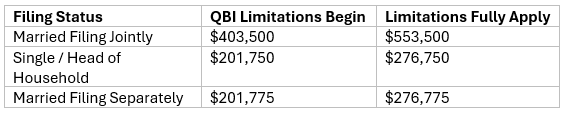
Below the threshold, eligible owners generally take 20% of QBI. Above it, limits tied to W-2 wages and qualified property start to apply, and specified service trades or businesses (SSTBs) begin losing the deduction. An owner with $420,000 of projected taxable income might restore much of the deduction by cutting $30,000, while an owner at $700,000 gets little QBI benefit from the same cut.
Year-end planning starts with a full tax projection covering business income, a spouse's income, retirement contributions, capital gains and other deductions. Starting in 2026, the law also adds a $400 minimum deduction for taxpayers with at least $1,000 of QBI from businesses they materially participate in.
Set S Corporation Shareholder Compensation Before the Final Payroll
An S corporation shareholder's W-2 wages don't count as QBI, though they can support the deduction when the W-2 wage limitation applies. For owners above the income threshold, the deduction may be limited to the greater of 50% of W-2 wages or 25% of wages plus 2.5% of the unadjusted basis of qualifying property.
Raising your salary lowers QBI and raises the wage limitation, so there's usually a compensation level where the two meet. You need to set it before the year's final payroll, because you can't change it once we're preparing the return.
Example: Year-End Payroll Planning Saves a $1 Million S Corporation Over $24,000
Take an S corporation with one shareholder and no other employees or qualifying property. It has $1,000,000 of QBI after the owner's existing $150,000 salary. The owners file jointly, sit well above the phase-in range in the 37% bracket, and the business isn't an SSTB.
The owner might expect a $200,000 deduction, but with only $150,000 of wages the deduction is capped at $75,000. A year-end bonus run through payroll changes the result:
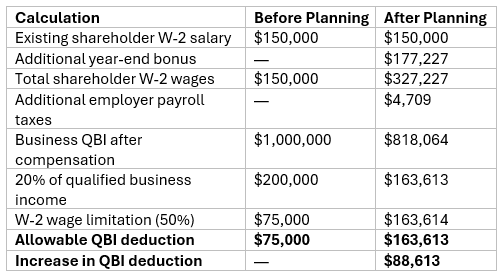
At about $177,000 of additional salary, 20% of QBI and 50% of wages land at nearly the same number, which is roughly where the deduction peaks. After payroll taxes, the federal savings look like this:
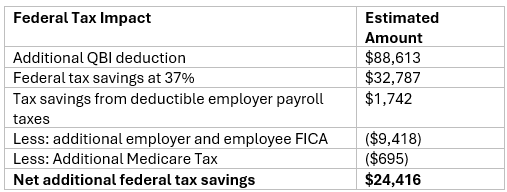
The bonus must run through 2026 payroll to count toward the 2026 wage limitation, so this can't wait until tax season.
This example assumes the added wages are reasonable compensation; neither spouse has other wages, and there's enough taxable income to use the full deduction. It leaves out state taxes and retirement contributions. Maximizing QBI doesn't always produce the lowest overall tax.
Coordinate Retirement Contributions With QBI
Pre-tax contributions to a 401(k), Solo 401(k), SEP IRA or cash balance plan can lower taxable income enough to restore some or all of a deduction your income was limiting. Certain business-related contributions also reduce QBI, though, so a $50,000 contribution may also shrink the income eligible for the 20% deduction. Calculate the tax savings and the QBI effect together, as one decision.
You can make some employer contributions after year-end, while employee deferrals and some plan setup requirements follow earlier deadlines. Choose your strategy and confirm its deadlines before December 31 so payroll and plan elections happen on time. For contribution limits, see our 2026 year-end tax planning guide for individuals .
Evaluate Equipment Purchases and Bonus Depreciation
With 100% bonus depreciation now permanent, you can generally write off property acquired after January 19, 2025, in full for 2026 if you place it in service by December 31.
Depreciation also reduces QBI. For an owner already getting the full 20% deduction, an extra $100,000 of depreciation might cut the QBI deduction by about $20,000. For another owner, the same deduction might lower taxable income enough to ease the W-2 wage or SSTB limitations. A new or larger business loss can also reduce QBI deductions in future years.
Before buying, confirm the asset qualifies and will be in service by year-end, and model how it affects taxable income and QBI. Equipment bought only for the deduction usually costs more in cash than it saves in tax.
QBI Opportunities for Rental Real Estate
Rental activity can qualify for QBI when it rises to the level of a trade or business. The IRS safe harbor generally requires 250 or more hours of qualifying rental services, such as tenant communications, lease negotiations, repairs and property management, along with separate records and contemporaneous documentation. The safe harbor excludes triple-net leases, and missing it doesn't automatically disqualify a rental from QBI.
For owners subject to the W-2 wage limitation, 2.5% of the unadjusted basis of qualifying depreciable property counts toward the alternative calculation, which helps portfolios with substantial real estate and little payroll. Before year-end, make sure your rental-service records and qualified-property schedules are complete. Properties rented to a commonly owned operating business deserve a closer look, since the self-rental rules can create additional QBI opportunities.
Consider Aggregating Commonly Owned Businesses
When one company produces most of the income and a related company carries most of the payroll or assets, the profitable company can hit a tight W-2 wage limitation. Section 199A lets qualifying businesses aggregate so wages and qualified property support the deduction across the group.
Aggregation generally requires at least 50% common ownership and enough operational connection between the businesses, and SSTBs can't be aggregated. A construction company and a related property or equipment company might qualify under the right facts. Once you elect to aggregate, you generally have to keep doing it in later years, so review ownership structures before returns are prepared.
Pay Special Attention to Specified Service Businesses
Many medical, legal, accounting, consulting and financial service businesses are SSTBs. Their deduction phases out across the phase-in range and disappears once taxable income passes $553,500 for joint filers or $276,750 for single filers. Engineering and architecture businesses are excluded from the SSTB category.
For owners near the upper threshold, a retirement contribution or another legitimate deduction might bring income back into the range and restore part of the deduction. Owners far above it may see little benefit from modest reductions.
Coordinate Pass-Through Entity Taxes With QBI
Many states let S corporations and partnerships elect to pay state income tax at the entity level, which can create a federal deduction outside the individual SALT limits. Those payments generally reduce QBI too, so a $50,000 PTET deduction might cut the QBI deduction by $10,000 for an owner getting the full 20%.
The election can still pay off, and it belongs in the full tax projection. Some states require payment by year-end for the federal deduction, so confirm your election and payment amount before December 31.
The QBI Year-End Planning Checklist
As 2026 wraps up, review these items with your CPA:
- Project 2026 taxable income to see where you fall within the QBI thresholds.
- Set S corporation compensation before the final payroll while meeting reasonable compensation requirements.
- Choose retirement contributions and confirm which elections or funding steps have to happen before year-end.
- Review capital purchases and depreciation for both the immediate tax savings and the QBI effect.
- Confirm rental real estate eligibility and the supporting documentation.
- Evaluate aggregation for commonly owned businesses.
- Identify SSTB limitations and ways to manage taxable income.
- Review PTET elections and payments to coordinate state and federal benefits.
- Run alternative tax scenarios to find the combination that produces the lowest overall tax.
Plan the QBI Deduction Before the Year Closes
Retirement contributions and shareholder compensation can each make sense on their own, and the best mix can change once QBI, payroll taxes, depreciation and state taxes enter the picture. We run year-end projections to find these opportunities while there's still time to act on them.
Schedule a year-end tax planning meeting and we'll run the numbers on your 2026 income before the year closes.
About Dark Horse CPAs
Dark Horse CPAs provides an integrated suite of services including tax , accounting , fractional CFO , and wealth management to small businesses and individuals across the U.S. The firm was established to transform the client experience by offering personalized, high-quality services that small businesses and individuals deserve. As Dark Horses in their industries, these businesses benefit from advanced tax strategies and accounting insights typically reserved for larger companies. With a nationwide presence and a team of dedicated professionals, Dark Horse CPAs is committed to your success. Get a quote today.